
Filling a shift is rarely the hard part. Proving the clinician was licensed for it, confirming they showed up, and paying them correctly by Friday — that's where healthcare staffing operations quietly lose hours every week. Modern healthcare scheduling software exists to close those gaps, but only when it's connected to the systems on either side of it: the applicant tracking system that sourced the candidate, the credentialing engine that cleared them, and the payroll and billing layer that settles the assignment.
Most agencies discover this the expensive way. They buy a strong scheduler, a separate ATS, and a credentialing tool, then hire a coordinator whose entire job is re-typing the same information into three places. This guide breaks down how these systems are supposed to work together, where the handoffs usually break, and what changes when scheduling is built natively into the recruiting platform rather than bolted on afterward.
At its simplest, scheduling software for healthcare assigns the right clinician to the right shift at the right facility. In practice, it manages a far messier reality: rotating per diem pools, multi-week travel contracts, floating between units, last-minute callouts, differentials that change by shift and day, and facility-specific rules about who can work where.
A capable platform handles shift creation and publishing, availability capture, self-scheduling and shift bidding, coverage gap alerts, overtime and fatigue rule enforcement, and mobile confirmation from the clinician's phone. Better systems layer in demand forecasting so agencies can pre-build pipelines instead of scrambling at 5 a.m.
The demand context matters here. The U.S. Bureau of Labor Statistics projects roughly 1.9 million healthcare job openings each year through 2034, driven by both growth and permanent workforce exits. At that volume, manual coordination doesn't scale — it just accumulates.
Think of a placement as a relay. Each handoff is a moment where information either flows cleanly or gets dropped.
The ATS holds the candidate's specialty, licenses, work history, preferences, and geography. The scheduler needs all of it to make a defensible assignment. When the two are separate, someone exports a list, imports it elsewhere, and the data starts aging immediately. A nurse who accepts a contract on Monday may still appear "available" in the scheduling tool on Wednesday.
Connected properly, the flow reverses: a candidate moves from submitted to confirmed inside one record, and their status updates everywhere at once. Recruiters stop calling people who are already booked.
This is the highest-stakes junction in the chain. Licenses expire. Competencies lapse. BLS and ACLS certifications renew on different cycles. Facility-specific requirements — flu shots, fit testing, background refreshes — vary by client.
Credentialing consumes a substantial share of recruiter time in agencies still tracking documents in spreadsheets and calendar reminders. More importantly, a manual process is a compliance liability: nothing stops a coordinator from assigning a clinician whose certification quietly lapsed last week. Integrated healthcare scheduling software makes that structurally impossible by checking credential status at the moment of assignment, not during an audit six months later.
Confirmed shifts become worked hours. Worked hours become paychecks and client invoices. When those steps involve manual re-entry, errors compound. Ernst & Young's payroll research found that one in five U.S. payrolls contains an error, at an average correction cost of $291 each, with the average organization making 15 corrections per pay period — and time and attendance mistakes ranking as the most common category.
For staffing agencies, the damage is doubled. A wrong hour is both an underpaid clinician and an under- or over-billed client. Trust erodes on both sides of the transaction.
"Integration" and "native" get used interchangeably in vendor marketing. They aren't the same thing.
Integrated means two separate products exchange data through an API or scheduled sync. It works, but it introduces latency, mapping errors, version drift, and a support conversation where each vendor points at the other.
Native means scheduling lives inside the same platform and reads from the same database as recruiting, credentialing, and timekeeping. There's no sync because there's nothing to sync — a credential update is instantly visible to the scheduler because it's the same record.
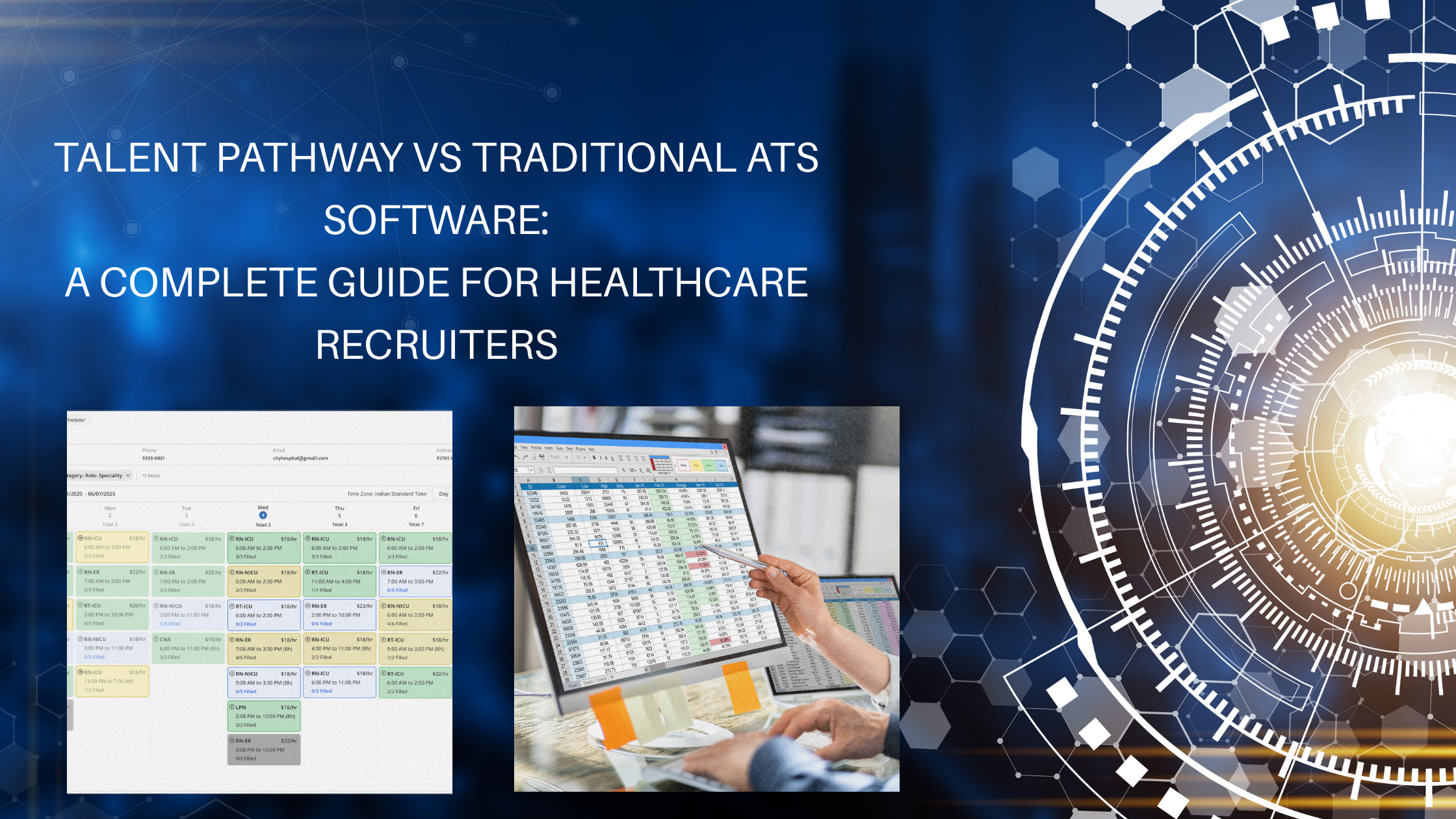
For high-velocity healthcare staffing, that difference shows up in minutes-to-fill, which is often the entire competitive margin. If you're currently comparing options, the criteria that separate real platforms from repackaged generic tools are laid out in this breakdown of the best healthcare scheduling software for staffing agencies in 2026.
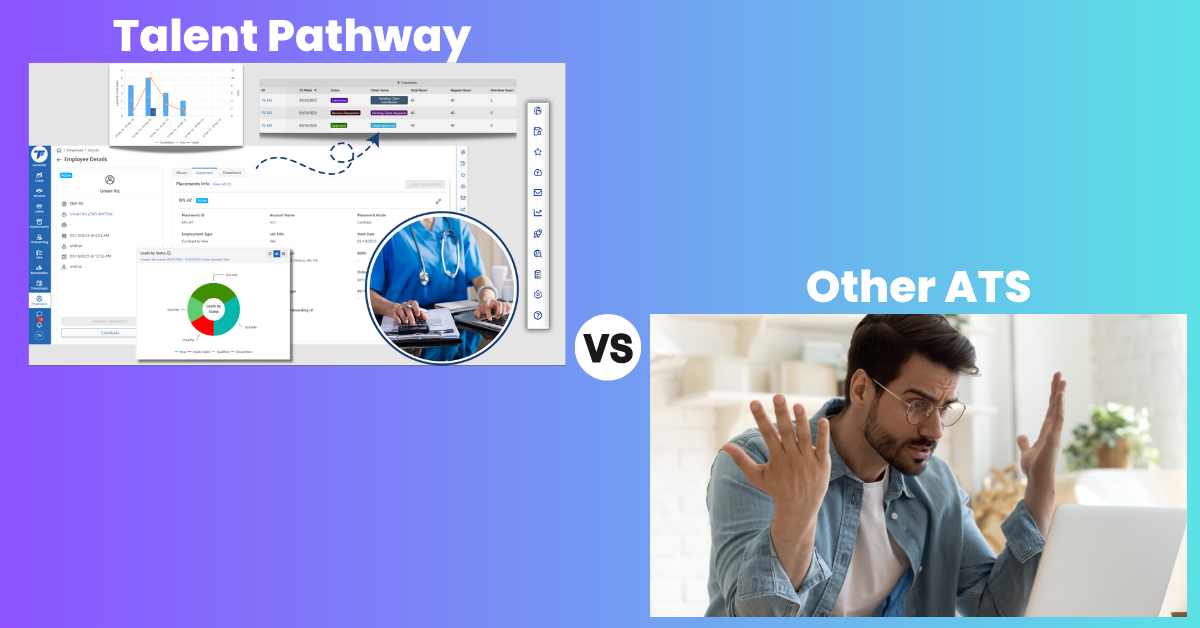
TalentPathway was built as a healthcare-first ATS, with scheduling as a native module rather than a partner integration. That design decision drives three practical outcomes.
A candidate sourced in TalentPathway carries a single profile through screening, credentialing, shift assignment, timekeeping, and payroll export. Nothing is re-keyed. When a recruiter updates availability after a phone call, the scheduling board reflects it immediately — and so does every other user looking at that clinician.
Credential status is a live attribute of the candidate record, not a separate file. TalentPathway surfaces expiring documents ahead of time and filters shift-matching by verified qualification, specialty, and facility-specific requirements. Recruiters see who is actually eligible for a shift, not who is theoretically available. Non-compliant assignments get blocked at the point of scheduling.
Because timekeeping inherits directly from the confirmed schedule, hours arrive pre-structured with the correct pay codes, differentials, and client rates attached. Payroll and billing pull from the same verified source, which removes the reconciliation step that consumes most of a payroll administrator's week.
The productivity argument is straightforward. Every hour a recruiter spends chasing a signed document, confirming a shift by text, or fixing a timesheet is an hour not spent submitting candidates.
Higher placement throughput. Faster credential-verified matching means submissions go out first — and in multi-agency environments, the first qualified submission usually wins the placement.
Less administrative drag. Automated reminders, mobile shift confirmation, and self-scheduling shift routine coordination onto the platform and the clinician, not the recruiter.
Better fill rates and lower cancellations. Clinicians who control their own availability cancel less. That connection between scheduling flexibility and workforce stability is explored further in this look at how healthcare scheduling software helps reduce nurse burnout and staffing gaps.
Real financial upside. The 2026 NSI National Health Care Retention & RN Staffing Report puts the average cost of a single staff RN turnover at $60,090, with national RN turnover at 17.6% and an average time-to-fill for experienced RNs of 78 days. Agencies that place faster and retain their clinician pool longer capture measurable value from both numbers.
When you assess healthcare scheduling software systems, look past the feature grid and ask operational questions:
Are facility-specific compliance requirements configurable per client?
Scheduling is not a standalone function — it's the hinge between recruiting and getting paid. When healthcare scheduling software sits natively inside the ATS, alongside credentialing and timekeeping, agencies stop maintaining systems and start running operations. Recruiters recover their week, clinicians get accurate paychecks, and clients get compliant coverage on the first submission.
TalentPathway brings applicant tracking, credentialing, scheduling, and timekeeping into one healthcare-built platform — so your team stops reconciling data and starts filling shifts faster.
Book a personalized TalentPathway demo and see how much administrative time your agency can reclaim.