
Filling clinical roles in 2026 is a different game than it was even two years ago. Vacancies stay open longer, credentialing rules keep tightening, and the cost of replacing a single staff nurse now runs north of $60,000. For agencies competing over the same shrinking pool of clinicians, the right healthcare recruitment software is no longer a back-office convenience—it's the engine that decides whether you fill the shift or lose it to a faster competitor. The challenge is that "recruiting software" now spans everything from generic applicant trackers to deeply specialized platforms built around licenses, shift work, and compliance. This guide cuts through that noise with a side-by-side look at the leading options, what they cost, and which type of agency each one actually fits.
General applicant tracking systems were built for corporate teams managing a handful of open requisitions. A staffing agency operates on an entirely different scale—juggling hundreds of credentialed clinicians across multiple facilities, each with role-specific licenses, expiry dates, shift schedules, and pay rates that change by location. A missed credential expiration isn't an inconvenience; it's a patient-safety risk and a hit to your agency's reputation.
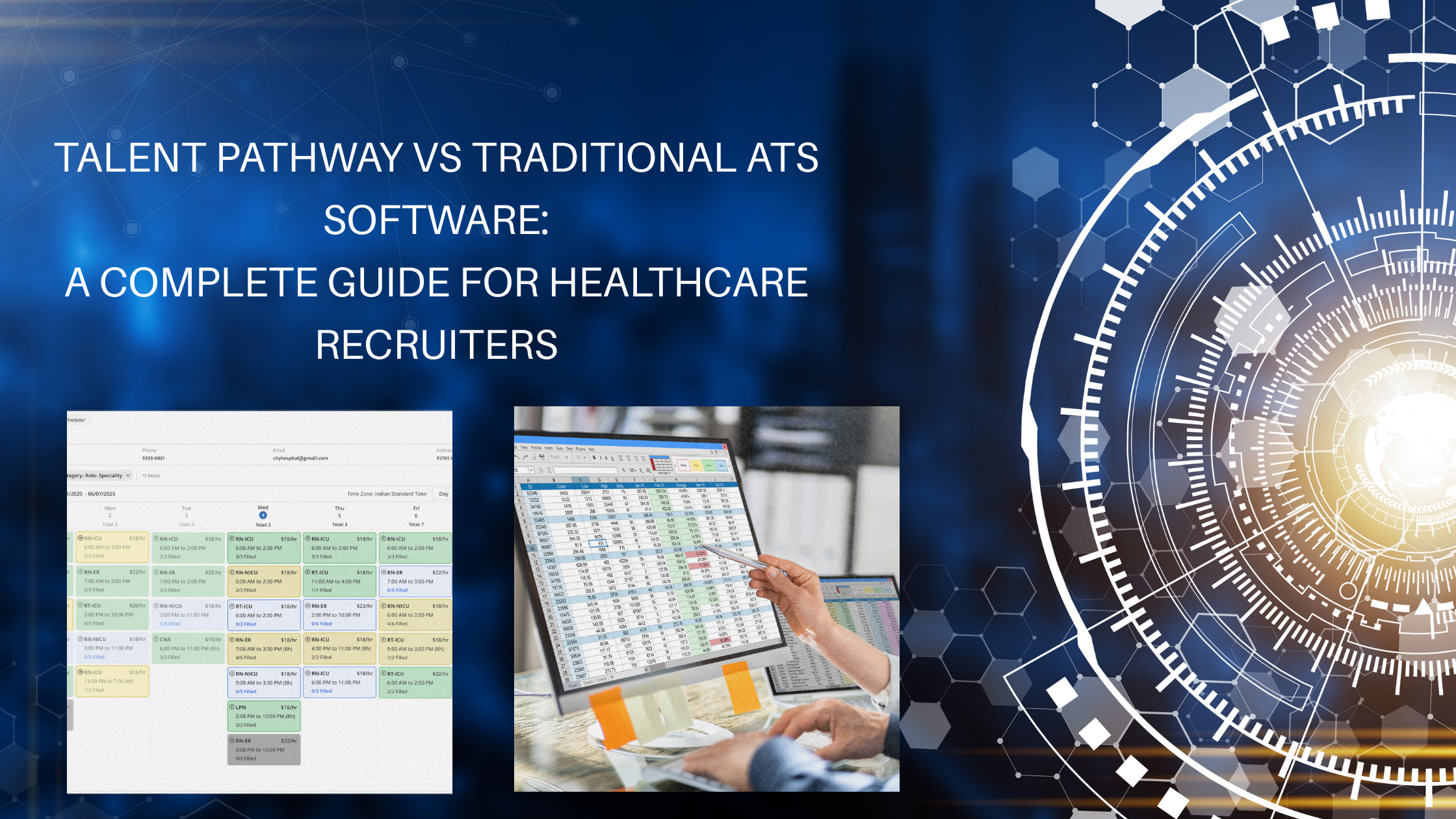
That's the core reason recruiters are moving away from spreadsheets and generic tools toward purpose-built systems. If you want a deeper breakdown of how a dedicated healthcare applicant tracking system reshapes day-to-day recruiting, the difference comes down to four things: automated credential management, shift-based placement logic, multi-channel job distribution to clinical job boards, and compliance baked into every workflow. The pressure isn't easing either—nursing and allied-health shortages are projected to persist through the end of the decade, which keeps the spotlight firmly on speed.
Before comparing vendors, map the steps between a candidate applying and the moment they're cleared to work a shift. That audit reveals exactly where your bottlenecks live. From there, prioritize platforms that deliver:
For a structured walkthrough of weighing these factors, this practical framework on how to choose the best healthcare staffing software is a useful companion to the comparisons below.
The long-standing market leader, Bullhorn unifies ATS and CRM in one system and is trusted by more than 10,000 staffing firms worldwide. Its embedded AI (Amplify) handles sourcing, screening, and outreach inside the recruiter's workflow, and its marketplace of 300+ integrations—plus connections to 110+ vendor management systems—makes it endlessly extensible.
Quote-based and not published. Third-party data puts base licensing between roughly $99 and $315 per user per month, with implementation ranging from $1,000 to $50,000+ and automation add-ons adding more. A five-person team's first-year total often lands near $19,000.
Mid-to-large, high-volume agencies that need a deep, customizable system and have the budget to match. Smaller boutique firms frequently pay for back-office capabilities they never use, which is reflected in Bullhorn's modest value-for-money scores.
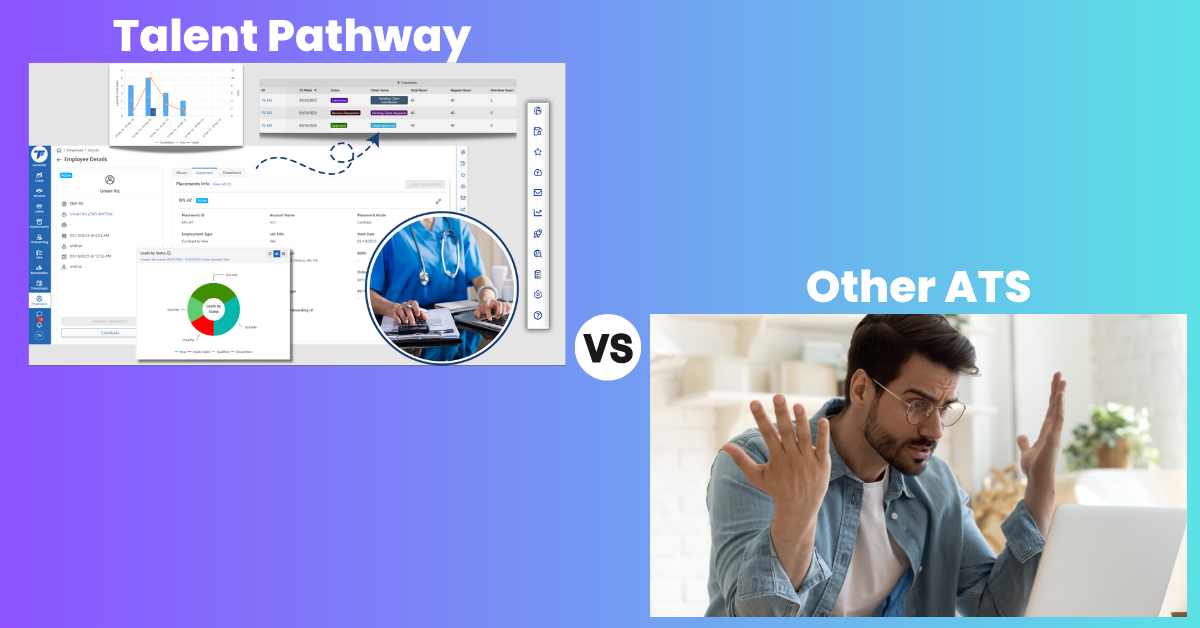
Built by recruiters for recruiters, Talent Pathway is a healthcare-first platform that combines applicant tracking, AI-powered candidate screening, automated credential and license tracking, and—notably—built-in PRN workforce management in the same system used for hiring. That last piece matters: instead of switching tools to staff open shifts, teams move from open shift to available clinician to confirmed placement in minutes. It also layers in CRM, HRIS, onboarding, invoicing, and role-specific BI dashboards, with deep integrations into healthcare job boards and VMS platforms like FieldGlass, HealthTrust, Medefis, and Vizient.
Custom, demo-based, tailored to agency size and module needs.
Healthcare staffing agencies—from nurse recruitment and allied health to physician recruitment—that want an all-in-one, compliance-ready system without the cost of a separate back-office team. Customers report placement turnaround dropping by nearly 40% and near-zero compliance errors.
Positioned as a "Staffing OS," Ceipal bundles an ATS, a native vendor management system, and workforce management into one platform serving 200,000+ recruiters. Its healthcare vertical is genuinely purpose-built, adding real-time license verification, credentialing compliance, expiration alerts, shift scheduling, GSA cost-sheet configuration, and 120+ specialty assessments. AI matching ranks candidates across 200+ job boards including Monster, Dice, and CareerBuilder.
Among the most affordable, starting around $24 per user per month, with the platform claiming it can replace four to six separate tools and cut technology spend significantly.
Cost-conscious small-to-midmarket agencies scaling up that want healthcare ATS depth without enterprise pricing. The trade-off: some users report performance lag and search inconsistencies when handling very large datasets.
Avionté (and its AviontéBOLD platform) is a complete operating system that ties front-office recruiting to back-office payroll and billing—processing over $15 billion in payroll across 1,800+ firms. For healthcare specifically, it offers expedited credentialing through partner integrations, video interviewing, a strong talent mobile app, and VMS consolidation that funnels multiple client requisitions into one workspace.
Custom, quote-based. No public starting price; cost scales with users, modules, and payroll volume.
Agencies that want recruiting and full back-office operations—payroll, billing, time and attendance—in a single system, particularly across the US and Canada. Some newer teams note a learning curve and an interface that can feel dated.
| Platform | Starting Price | Healthcare Depth | Best Fit |
|---|---|---|---|
| Bullhorn | ~$99–$315/user/mo (quote) | Via configuration & partners | Large, high-volume agencies |
| Talent Pathway | Custom (demo) | Purpose-built, PRN-ready | Healthcare-focused staffing agencies |
| Ceipal | ~$24/user/mo | Strong, dedicated vertical | Cost-conscious, scaling firms |
| Avionté | Custom quote | Strong, payroll-integrated | Front + back office in one |
Choosing healthcare recruitment software isn't just about checking feature boxes. Consider how the platform fits your agency's long-term strategy.
Ask these questions:
A platform that saves recruiters several hours each week often delivers greater long-term value than one with a lower subscription cost.
Price should be the last filter, not the first. Start with your role mix and your biggest bottleneck. If credentialing eats your week, weight compliance automation heavily. If unfilled per-diem shifts are the leak, prioritize real-time PRN tools. If you're running payroll in-house, an integrated back office may justify a higher price. And if your recruiters are drowning in résumés, the quality of the AI matching engine will move the needle more than any other feature.
It's also worth understanding why so many teams are abandoning generic tools altogether—this look at why recruiters are switching from a traditional ATS to a healthcare-specific system explains the operational gaps that general platforms leave open. Once you've narrowed the field, a methodical approach to shortlisting the best tools for your agency keeps the evaluation honest and demo-driven rather than feature-list driven.
There is no single "best" platform—only the best fit for your agency's size, specialties, and growth plans. Bullhorn rewards scale, Ceipal rewards budget discipline, and Avionté rewards firms that want payroll under the same roof. But for agencies whose entire business is placing clinicians, the strongest healthcare recruitment software is the one engineered around credentialing, shift work, and compliance from the ground up—not adapted from a corporate hiring tool. In a market this competitive, that purpose-built advantage is often the difference between filling the shift and watching it go elsewhere.
Talent Pathway brings AI-powered sourcing, automated credential tracking, PRN shift management, and full compliance into one platform built specifically for healthcare staffing—so your recruiters spend less time on admin and more time placing the professionals who keep patients cared for. Book your free demo today and see how much faster your team can move.