
Getting promoted from top-billing recruiter to team lead comes with an uncomfortable realization: the skills that made you great at the desk don't automatically make your team great. You can't out-hustle a productivity problem across eight people. What actually works are healthcare recruitment strategies that remove friction systematically — better desk design, tighter processes, and technology that eliminates work rather than adding to it.
This matters more in 2026 than it did three years ago. The pandemic-era boom is over. Staffing Industry Analysts projects only modest growth for healthcare staffing revenue in 2026 after a contraction year, which means growth now has to come from output per recruiter rather than headcount. If you're a newly promoted head, lead, or director, that's your mandate — whether or not anyone said it out loud.
Most new leaders inherit a dashboard full of activity metrics: calls made, emails sent, resumes reviewed. These feel like productivity. They aren't. A recruiter can make 80 calls a day and place nobody.
Any healthcare recruitment strategy worth building starts with the right scoreboard. The metrics that predict revenue are conversion ratios and cycle time — submission-to-interview, interview-to-offer, offer-to-start, and days from req to placement. When a recruiter underperforms, the diagnosis almost always sits at one specific stage. Fixing a screening problem with more sourcing activity is the most common and most expensive mistake in the industry.
The demand backdrop is genuinely strong. The U.S. Bureau of Labor Statistics projects roughly 1.9 million healthcare job openings each year through 2034. The constraint isn't opportunity — it's how much of it your team can convert.
Generalist desks look flexible and perform poorly. A recruiter covering ICU, OR, imaging, and behavioral health simultaneously never builds fluency in any of them — they can't speak credibly to a cath lab nurse about ratios or to a rad tech about modality certifications.
Among the best healthcare recruiting strategies available to a new lead, this one costs nothing. Specialized desks compound. The recruiter's network deepens, their screening judgment sharpens, and their credibility on the phone improves. Most agencies see meaningful conversion gains within two quarters of restructuring desks by clinical vertical, without changing a single person on the team.
In multi-agency environments, the first qualified submission usually wins. Bullhorn's 2026 GRID Industry Trends Report found that 56% of top-performing agencies now report placement times under 10 days — a benchmark that would have seemed implausible a few years ago.
Compare that to the hospital side, where NSI's 2026 report puts average time-to-fill for an experienced RN at 78 days. That gap is your value proposition. Protect it with internal SLAs: response to a new req within an hour, first submission within 24 hours, candidate callback within 15 minutes of an inbound application.
Credentialing is where healthcare placements die. A candidate accepts on Tuesday, and then someone discovers their ACLS lapsed, the facility requires a specific fit test, or a state license transfer takes three weeks.
Effective recruitment strategies for healthcare treat this as a sequencing problem rather than a chasing problem. Start document collection at first contact, not at offer. Maintain a permanent, continuously updated compliance profile for every clinician in your database rather than rebuilding it per assignment. Automate expiry alerts 60 and 30 days out. Every hour a recruiter spends chasing a document is an hour not spent on a placement conversation.
Reactive sourcing is the most expensive way to fill a req, and it quietly caps how much any healthcare recruitment strategy can deliver. Proactive pooling — segmented, warm, and regularly engaged — is where high-performing teams get their margin.
Two sources deserve disproportionate attention. Redeployment: clinicians finishing assignments who are already credentialed with you. And silver-medalist candidates: qualified people who lost out on a previous submission. Both convert at multiples of cold pipeline because the trust and paperwork already exist.
Every disconnected system charges your team a tax in duplicate data entry. Recruiters working across a separate ATS, credentialing tracker, scheduling tool, and spreadsheet are losing time to reconciliation that produces zero revenue.
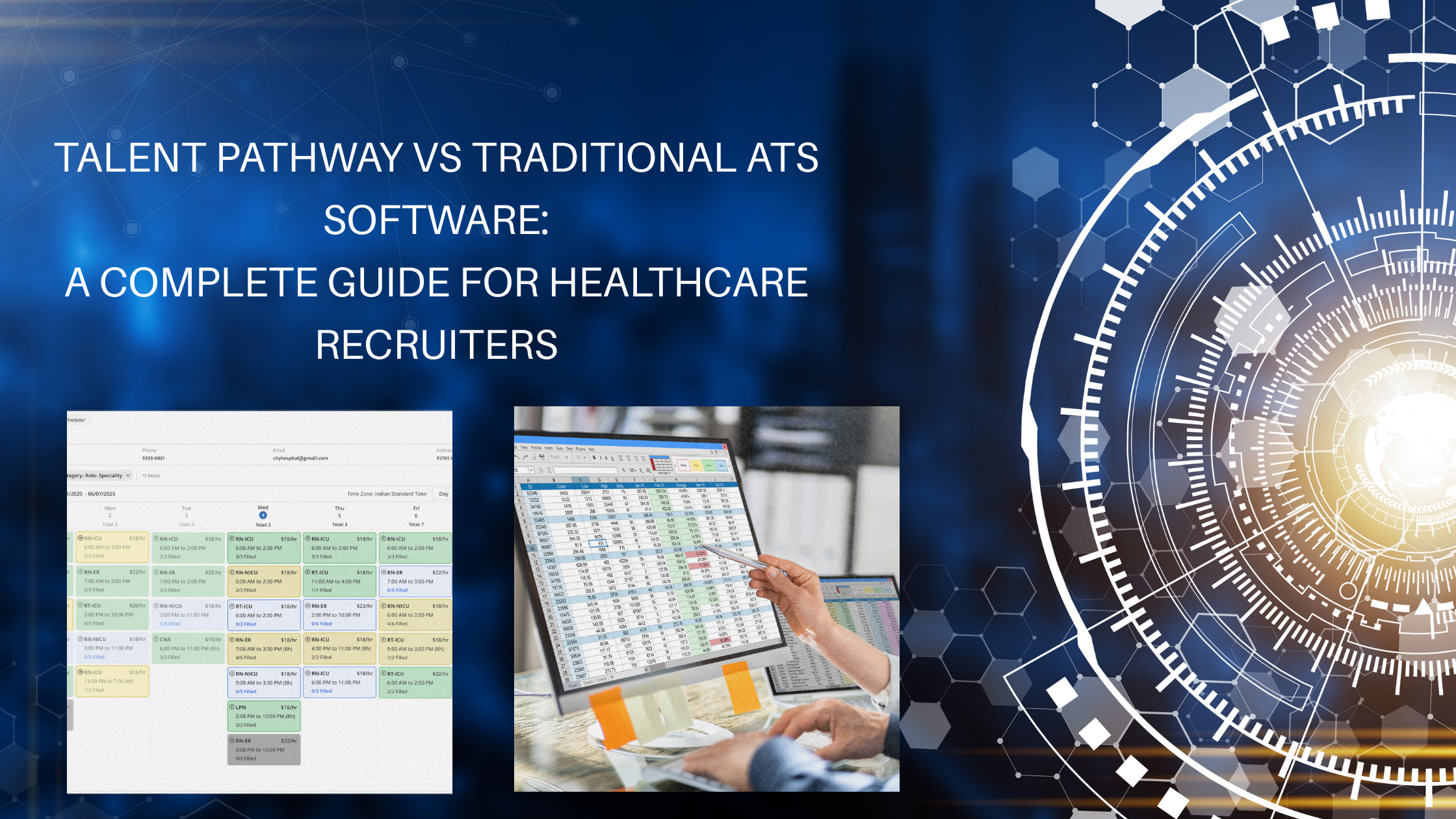
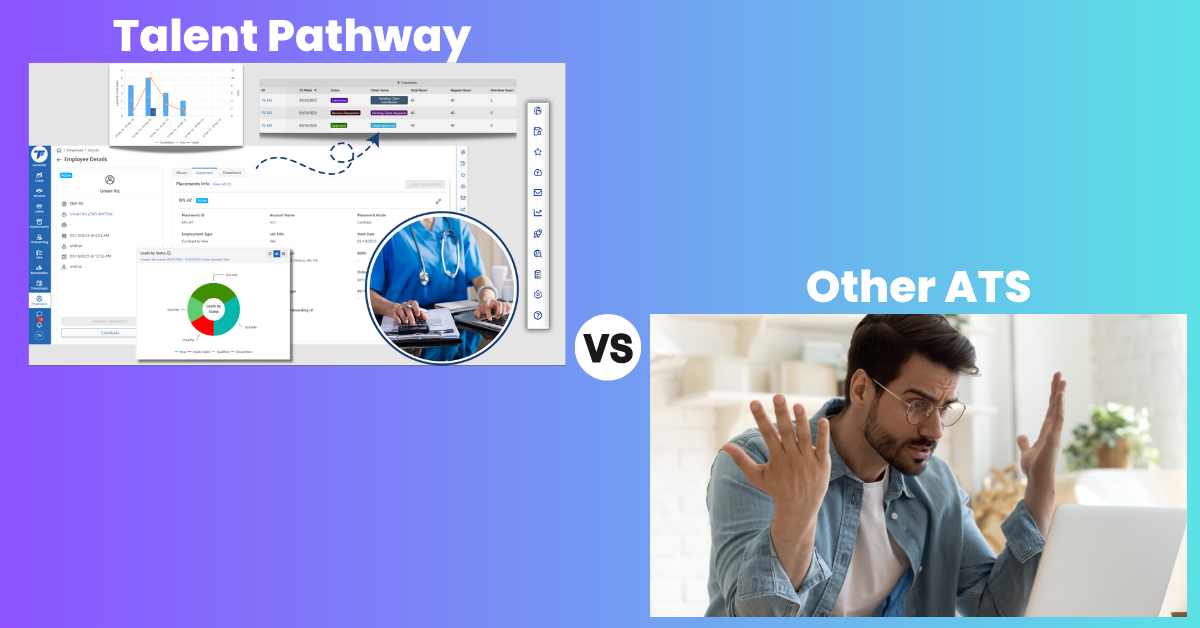
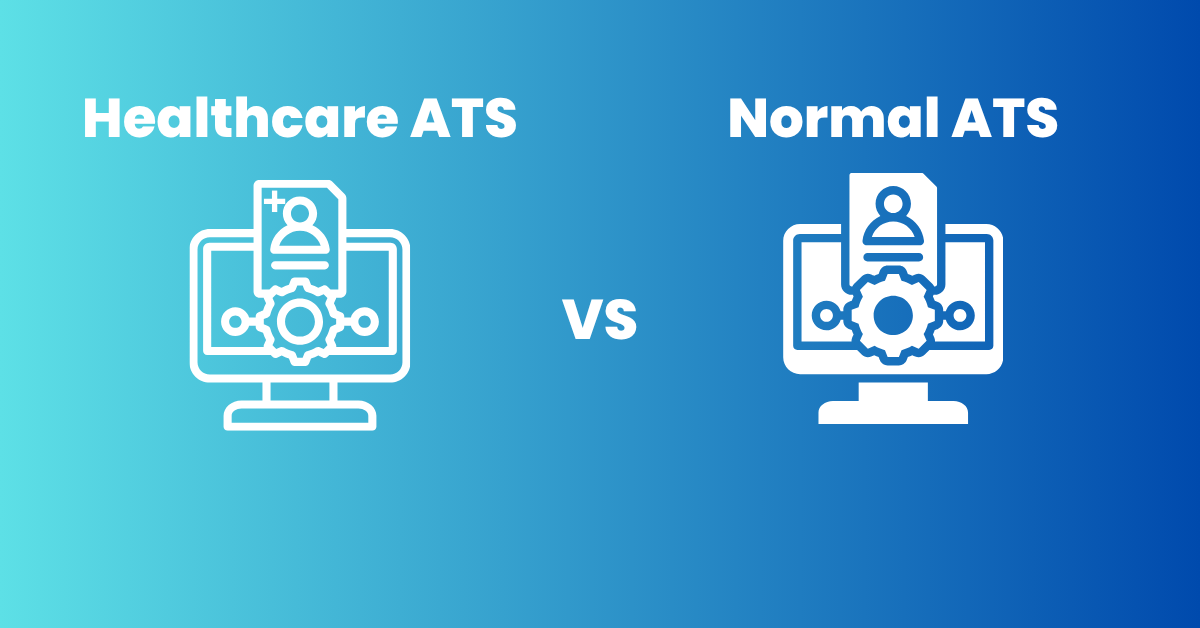
Bullhorn's research indicates AI and automation could free up to 17 hours per recruiter per week, with roughly 4.5 hours going to candidate search and 3.6 hours to screening and administrative work. Capturing that requires a unified system, and the practical differences between a healthcare-built platform and a repurposed general recruiting tool are worth understanding before you commit — this comparison of TalentPathway versus traditional ATS software covers where the gaps typically appear.
Automation fails when leaders apply it indiscriminately. The rule is simple: automate anything that doesn't require human judgment, and protect anything that does.
Good candidates for automation include interview scheduling, document reminders, credential expiry alerts, submission status updates, timesheet nudges, and initial application acknowledgments. Poor candidates include specialty screening conversations, offer negotiation, client relationship management, and anything involving a clinician's career decision.
The agencies pulling ahead understand this distinction. GRID found that firms using AI across the recruitment cycle were 3.5 to 4.5 times more likely to report revenue growth — not because AI replaced recruiters, but because it returned their hours to work only humans can do.
Healthcare candidates are the least likely group to rely on agencies. GRID's talent research found that only 30% of healthcare candidates turn to recruitment firms first, with the majority starting on job boards and LinkedIn instead.
That means every friction point — an unanswered application, a slow callback, a redundant document request — costs you a clinician who had alternatives. Responsiveness isn't a nice-to-have; it's how you stay relevant against 24/7 self-service platforms.
The hardest transition for new leaders is shifting from producing to enabling. Three habits separate the leads whose teams improve from those whose teams plateau.
Coach to the ratio, not the outcome. Review one recruiter's funnel weekly and identify the single weakest conversion point. Work on that stage only, for four weeks. Broad feedback changes nothing.
Shorten the ramp deliberately. New recruiters typically take six to nine months to hit full productivity. Structured onboarding, a specialized desk, and a pre-built starter pool can compress that meaningfully — and ramp time is one of the largest hidden costs on any team.
Plan capacity honestly. A recruiter can hold a finite number of active reqs before quality collapses. Assigning more work to your strongest performer is a common instinct and a reliable way to burn them out.
Even well-designed recruitment strategies in healthcare fail in predictable ways. Three patterns show up repeatedly. Adding headcount to solve a conversion problem, which multiplies the inefficiency. Buying point solutions for individual pain points until the stack itself becomes the bottleneck. And managing by activity dashboards that reward motion over results.
If you're evaluating your core platform this year, the criteria that matter for clinical staffing — compliance depth, credential automation, redeployment tooling — are laid out in this guide to choosing the right applicant tracking system for healthcare staffing.
The healthcare recruitment strategies that raise productivity aren't exotic. Specialize your desks. Compete on speed. Move credentialing forward. Build pools ahead of demand. Consolidate your stack and automate the work that doesn't need a human. Then coach against ratios rather than activity.
None of these healthcare recruitment strategies requires hiring more people. All of it requires a leader willing to change the system instead of pushing the team harder.
TalentPathway unifies applicant tracking, credentialing, compliance, and scheduling in one healthcare-built platform — so your team spends less time on administration and more time placing clinicians.
Book a personalized TalentPathway demo and see what your team's productivity looks like without the friction.