Nurse Onboarding in PRN Staffing: Pain Points, Process, and How to Reduce Time-to-Clear
If you run or operate a PRN healthcare staffing agency, you already know this:
Sourcing nurses is not the bottleneck.
Getting them cleared to work is.
This stage—often referred to as credentialing, compliance, or onboarding—has a direct impact on fill rates, revenue per nurse, client satisfaction, and candidate experience.
And yet, it’s where most agencies still rely on manual workflows, disconnected systems, and constant follow-ups.
In the world of PRN staffing, where speed and flexibility define success, onboarding delays can quietly erode your operational efficiency.
Key Highlights
- Nurse onboarding is the biggest bottleneck in PRN staffing—not sourcing
- Time-to-clear directly impacts revenue, fill rates, and client satisfaction
- Manual workflows and disconnected systems slow down onboarding
- Facility-specific compliance adds complexity to every placement
- Lack of visibility leads to delays, errors, and missed opportunities
- Integrated platforms like Talent Pathway streamline onboarding and improve readiness
What Is Nurse Onboarding in PRN Staffing?
In PRN staffing, nurse onboarding is the process of making a candidate eligible to work at a specific healthcare facility.
This process typically includes:
- Skill assessments
- Credentialing and document verification (agency + facility requirements)
- Background checks and reference validation
- Agency and facility orientations
- Interviews or approvals (in some cases)
Here’s the critical complexity:
A nurse eligible for one facility is not automatically eligible for another.
This is what makes onboarding in PRN staffing uniquely challenging—and why it often becomes a major operational bottleneck.
Why Nurse Onboarding Is Critical in PRN Healthcare
Unlike permanent hiring, PRN staffing operates under very different conditions:
- Short turnaround times
- High compliance requirements
- Frequent redeployment across multiple facilities
This creates a simple equation:
- Delays = Lost shifts
- Errors = Compliance risk
- Poor experience = Candidate drop - off and lower engagement
Onboarding is not just an administrative step—it’s the gateway to revenue.
The faster you can move a nurse from “sourced” to “cleared,” the stronger your operational performance.
Top Pain Points in Nurse Onboarding
Despite its importance, onboarding remains one of the least optimized parts of the staffing lifecycle.
1. Long Time-to-Clear (Time-to-Eligibility)
One of the most common challenges in PRN staffing is slow onboarding timelines.
Delays often occur due to:
- Pending documents
- Facility approvals
- Background checks
- Manual coordination between teams
Impact:
- Nurses remain idle
- Shifts go unfilled
- Increased cost of underutilized talent
2. Manual Processes and Disconnected Workflows
Many agencies still rely on:
- Email threads
- Phone or WhatsApp follow-ups
- Excel trackers
- Notes scattered across ATS systems
Even when systems exist, onboarding often sits outside the core workflow.
Impact:
- Duplicate work
- Missed follow-ups
- No single source of truth
3. Document Collection and Credentialing Delays
Credentialing requires multiple documents, including:
- Nursing licenses
- Certifications (BLS, ACLS, etc.)
- Immunization records
- IDs and compliance forms
Common challenges:
- Missing or expired documents
- Incorrect uploads
- Repeated follow-ups
Impact:
- Delayed onboarding
- Frustrated candidates
- Increased recruiter workload
4. Facility-Specific Requirements
Every healthcare facility operates differently.
Each one may have:
- Unique onboarding checklists
- Different compliance rules
- Separate approval processes
While some platforms handle parts of this, many agencies still manage these variations manually.
Impact:
- Rework for every placement
- Slower redeployment
- Operational inefficiency
5. Lack of Visibility into Candidate Status
A common operational question remains unanswered in many agencies:
- What’s pending?
- Who is blocked?
- When will the nurse be ready?
Without real-time visibility, teams are forced into reactive mode.
Impact:
- Poor planning
- Overpromising to clients
- Constant firefighting
6. Errors and Compliance Risks
Small issues can have major consequences:
- Expired licenses
- Missing documents
- Incorrect data
Impact:
- Placement delays
- Shift cancellations
- Compliance risks and regulatory exposure
- Client dissatisfaction
Where Traditional Systems Fall Short
Most ATS and CRM platforms are designed to manage sourcing and recruitment at a high level.
They can:
- Track candidates
- Manage pipelines
- Support communication
But they often fall short when it comes to:
- Deep onboarding workflows
- Real-time credentialing visibility
- Facility-level compliance tracking
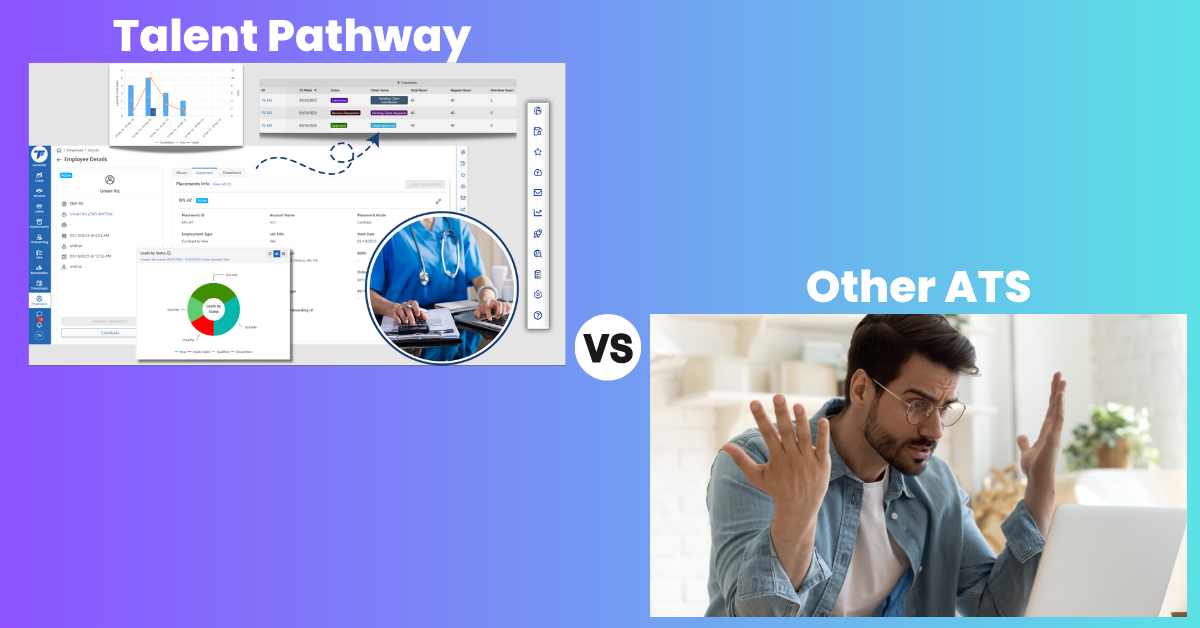
This is where the process typically breaks down in PRN staffing operations and purpose-built platforms like Talent Pathway start to make a measurable difference.
How Talent Pathway Solves Nurse Onboarding in PRN Staffing
Talent Pathway is designed to manage the full lifecycle—not just recruitment, but onboarding and workforce readiness.
Here’s how it addresses the core challenges:
1. Reduced Time-to-Clear
- Tracks every onboarding step as a structured pipeline
- Identifies bottlenecks instantly
- Enables faster turnaround from sourcing to deployment
2. Workflow Automation
- Task-based onboarding workflows
- Automated reminders and follow-ups
- Reduced manual coordination across teams
3. Centralized Document Management
- Single repository for all candidate documents
- Clear visibility into “missing vs. completed” items
- Eliminates repetitive back-and-forth communication
4. Facility-Specific Configuration
- Custom onboarding workflows for each facility
- Reusable nurse profiles across clients
- Faster redeployment without starting from scratch
5. Real-Time Visibility
- Single-screen tracking for recruiters and operations teams
- End-to-end visibility from recruitment to onboarding
- Improved planning and forecasting
6. Built-in Compliance Controls
- Automated expiry tracking
- Structured onboarding checkpoints
- Reduced risk of compliance errors
Key Benefits for Staffing Agencies
With a structured platform built for PRN staffing, agencies can achieve:
- Faster nurse onboarding
- Higher fill rates
- Increased revenue per nurse
- Reduced operational workload
- Improved candidate experience
- Stronger compliance and audit readiness
The Bigger Picture: Why This Matters
In PRN staffing, success isn’t defined by how many nurses you source.
It’s defined by how quickly and reliably you can make them eligible to work.
That’s where most agencies struggle—and where modern onboarding platforms create a real competitive advantage.
Conclusion
Nurse onboarding is no longer just a backend process—it’s a critical driver of performance in PRN staffing.
Manual workflows, fragmented systems, and lack of visibility are not just operational
inefficiencies—they’re revenue leaks.
By adopting an integrated, workflow-driven approach, staffing agencies can:
- Reduce time-to-clear
- Improve workforce utilization
- Enhance candidate and client experience
- Stay competitive in a fast-evolving market
If you’re still managing onboarding through emails, spreadsheets, or disconnected tools, you’re not just losing efficiency—
you’re losing opportunities.
Ready to Reduce Time-to-Clear in PRN Staffing?
Talent Pathway is built to help healthcare staffing agencies streamline onboarding, improve compliance, and accelerate workforce readiness.
With a unified platform covering recruitment, onboarding, and shift management, you can:
- Move nurses from sourced to cleared faster
- Gain full visibility into onboarding pipelines
- Reduce manual effort and errors
- Deliver a seamless experience for candidates and clients
In PRN staffing, speed is everything—and onboarding is where it starts.
Written by D Harish Patnaik, a Senior Product Manager, Talent Pathway - Healthcare Applicant Tracking System.