
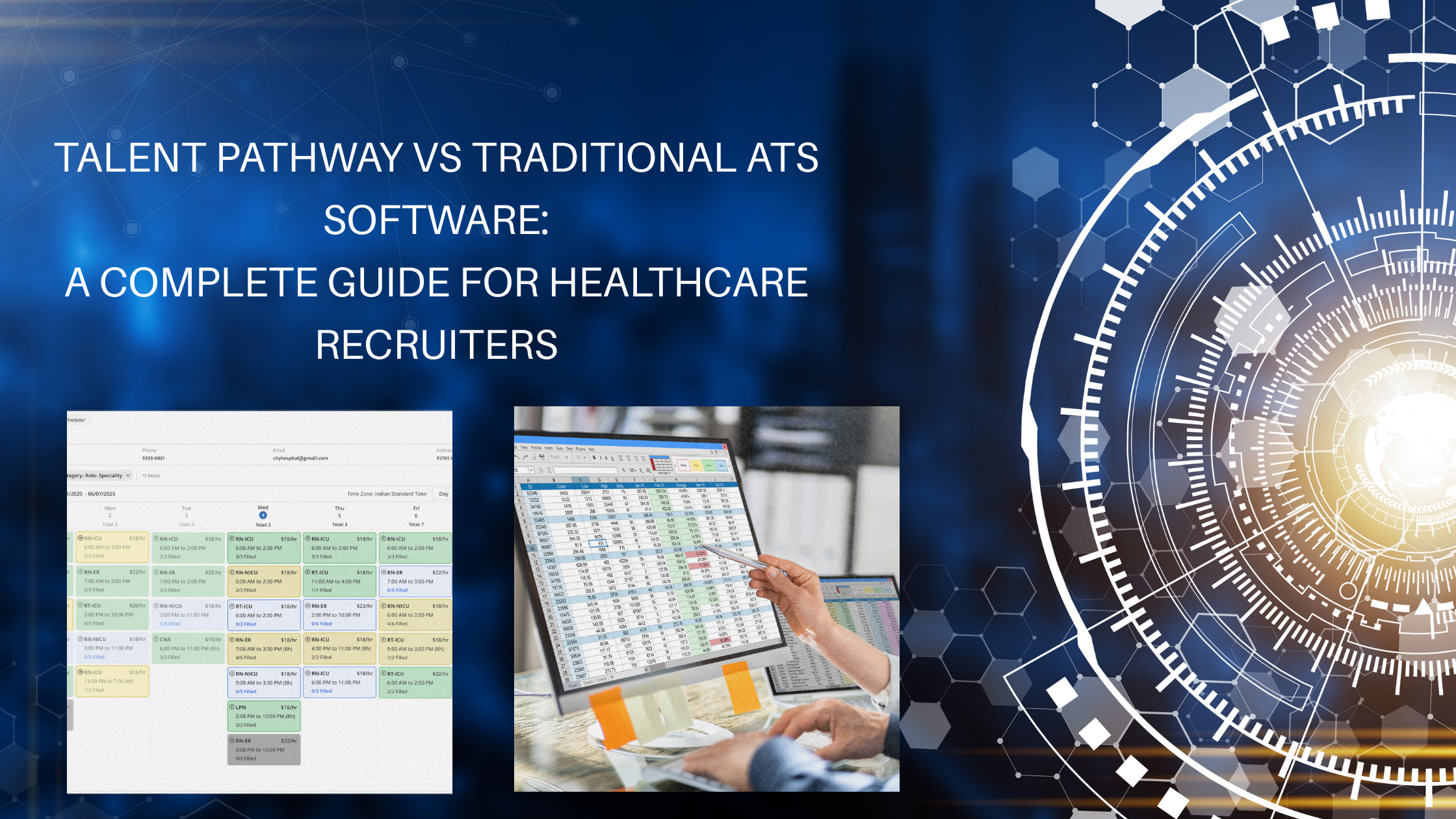
Most recruiting teams start with a general applicant tracking system because it's familiar, affordable, and "good enough" for posting jobs and collecting résumés. But the moment hiring involves licenses, certifications, and shift-based placements, that familiar tool starts to crack. A standard healthcare ATS conversation usually begins here: recruiters discover that the software running their pipeline was never built for the realities of clinical staffing. Credentials expire mid-assignment, compliance checks live in spreadsheets, and a single missed document can stall a placement for days. This guide breaks down exactly how a purpose-built platform like Talent Pathway differs from traditional applicant tracking software—and why that difference matters more in healthcare than in any other industry.
A traditional ATS is essentially a digital filing cabinet with a hiring workflow attached. It captures applications, parses résumés, moves candidates through stages, and stores communication history. For a corporate HR team managing a few open roles at a time, that's often all that's needed.
Healthcare staffing operates on a fundamentally different scale. Agencies manage hundreds of credentialed professionals across multiple facilities, each with role-specific licenses, expiry dates, shift requirements, and pay rates that shift by location. A generic system has no concept of a nursing license that lapses in 30 days, no logic for matching an open shift to an available per-diem clinician, and no native way to verify that every placed candidate meets state and facility requirements. Recruiters end up bolting on spreadsheets, separate credentialing trackers, and standalone scheduling tools—recreating manually what a specialized platform handles automatically. The hidden cost isn't just wasted hours; it's lost placements to faster competitors and compliance exposure that can damage client relationships.
This is the gap that separates corporate hiring software from clinical recruiting software, and it's worth understanding the key differences between a healthcare ATS and a general ATS before committing budget to either.
A purpose-built healthcare applicant tracking system starts from the assumption that compliance and speed are inseparable. Instead of treating credentials as an afterthought, it makes them a core data type—tracked, monitored, and flagged automatically. Instead of ending at the offer, it carries the candidate through onboarding and into active shift management. The platform understands clinical roles, from registered nurses and travel nurses to physicians, allied health professionals, and technicians, and it shapes its workflows around how those roles are actually hired.
That shift in design philosophy is precisely why so many teams are moving on. The reasons recruiters are switching away from traditional ATS platforms in 2026 come down to one theme: software should remove operational complexity, not add to it.
| Capability | Traditional ATS | Talent Pathway |
| Credential & license tracking | Manual or external add-on | Built-in with automated expiration alerts |
| Healthcare onboarding | Generic forms | Structured clinical onboarding workflows |
| Shift & PRN scheduling | Not supported | Native PRN workforce management |
| AI candidate matching | Basic keyword search | AI-powered sourcing, screening, and ranking |
| Compliance & audit trails | Spreadsheet-dependent | Secure, audit-ready documentation |
| VMS & job-board integrations | Limited | Deep healthcare VMS + job-board connections |
| System sprawl | 4–5 separate tools | One centralized platform |
| Built for | Corporate hiring | Healthcare staffing teams |
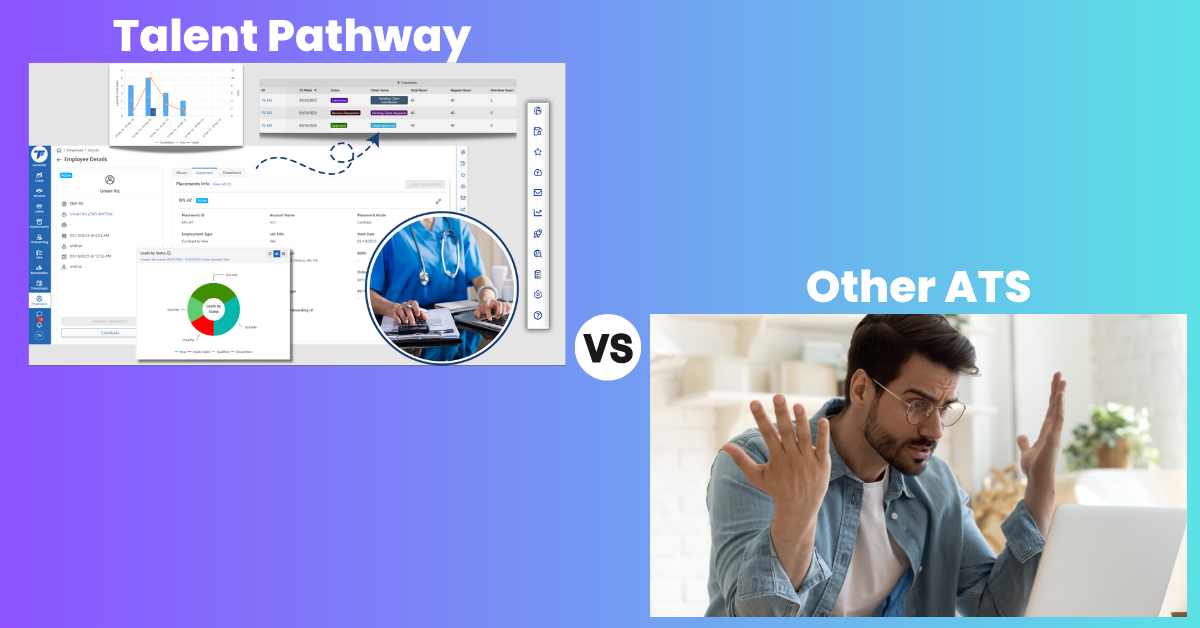
Talent Pathway was designed by recruiters for recruiters, which shows in how tightly its features map to real clinical hiring problems.
Healthcare credentialing is where most generic systems fall apart. Talent Pathway tracks licenses, certifications, and documentation in one place, with automated alerts for upcoming expirations so a lapse never blindsides a recruiter or stalls a placement. Sensitive candidate data is stored securely with role-based access, keeping records audit-ready and reducing compliance risk across the board.
Once a clinician is selected, momentum matters. Structured onboarding workflows accelerate document collection, verification, and new-hire integration, so qualified professionals start working sooner. By keeping healthcare onboarding inside the same system used for sourcing and credentialing, teams avoid the handoffs and dropped details that cost agencies their best candidates.
This is where Talent Pathway pulls decisively ahead of a standard ATS. Most platforms stop at the hire; Talent Pathway carries straight into healthcare scheduling with native PRN workforce management. Recruiters can view real-time availability of clinicians, instantly match open shifts to ready-to-work candidates, send bulk or targeted shift notifications, and track confirmations live—moving from open shift to confirmed placement in minutes rather than hours, without juggling spreadsheets.
Talent Pathway uses AI in healthcare staffing to surface qualified clinicians faster. Its AI assistant, Theo, helps shortlist candidates and automate repetitive screening, so recruiters spend less time sifting résumés and more time engaging people. Advanced filters and centralized pipelines keep every candidate visible from application to placement, while role-specific BI dashboards give managers real-time insight into performance and pipeline health.
Beyond recruiting, the platform folds in CRM, HRIS, onboarding, invoicing, and reporting, with integrations spanning leading healthcare job boards and vendor management systems such as FieldGlass, HealthTrust, Medefis, and Vizient. Instead of stitching together five tools, agencies run hiring, compliance, and placement from a single dashboard.
The case for switching isn't about features for their own sake—it's about outcomes. When credential tracking, onboarding, and scheduling live in one place, recruiters stop chasing paperwork and start filling more roles. Agencies using Talent Pathway report placement turnaround dropping by nearly 40% and compliance errors falling close to zero, while operations leaders note the platform can replace the work of an entire back-office team.
There's also a competitive dimension. Qualified clinicians often field multiple offers at once, so the agency that can source, credential, and confirm fastest wins the placement. A system built to boost efficiency and compliance for healthcare staffing agencies turns that speed into a structural advantage rather than a daily scramble. For recruiters weighed down by manual workflows, that's the difference between reacting to demand and getting ahead of it.
Just as importantly, the platform scales. Whether a team is running high-volume nurse staffing or placing specialized physicians, the same flexible workflows, multi-role tracking, and shift-based tools adapt without adding administrative drag. Growth doesn't mean re-platforming—it means doing more within a system that was built to expand.
A traditional ATS will always have a place for straightforward corporate hiring. But healthcare recruiting runs on credentials, compliance, and shifts—and a generic tool simply wasn't engineered for any of them. The right healthcare ATS closes those gaps by automating credentialing, streamlining onboarding, managing scheduling, and applying AI to sourcing, all inside one platform. For recruiters who place clinicians for a living, that purpose-built foundation isn't a luxury; it's what keeps placements moving and clients confident. Talent Pathway delivers exactly that—software shaped around how healthcare staffing actually works.
Stop forcing clinical hiring into software built for corporate roles. Talent Pathway brings AI-powered sourcing, automated credentialing, healthcare onboarding, and real-time PRN scheduling into one platform designed specifically for healthcare staffing teams. Book your free demo today and discover how much faster—and more compliant—your recruiting can be.